Snap Back
After a sluggish start to the year, the S&P 500 Index recorded its best quarter in six years, and the Russell 2000 (Small Cap) Index recorded its best first six months in 35 years¹. Bonds eked out a return of less than 1% for the first six months of the year, while commodities have collectively been strong but volatile.
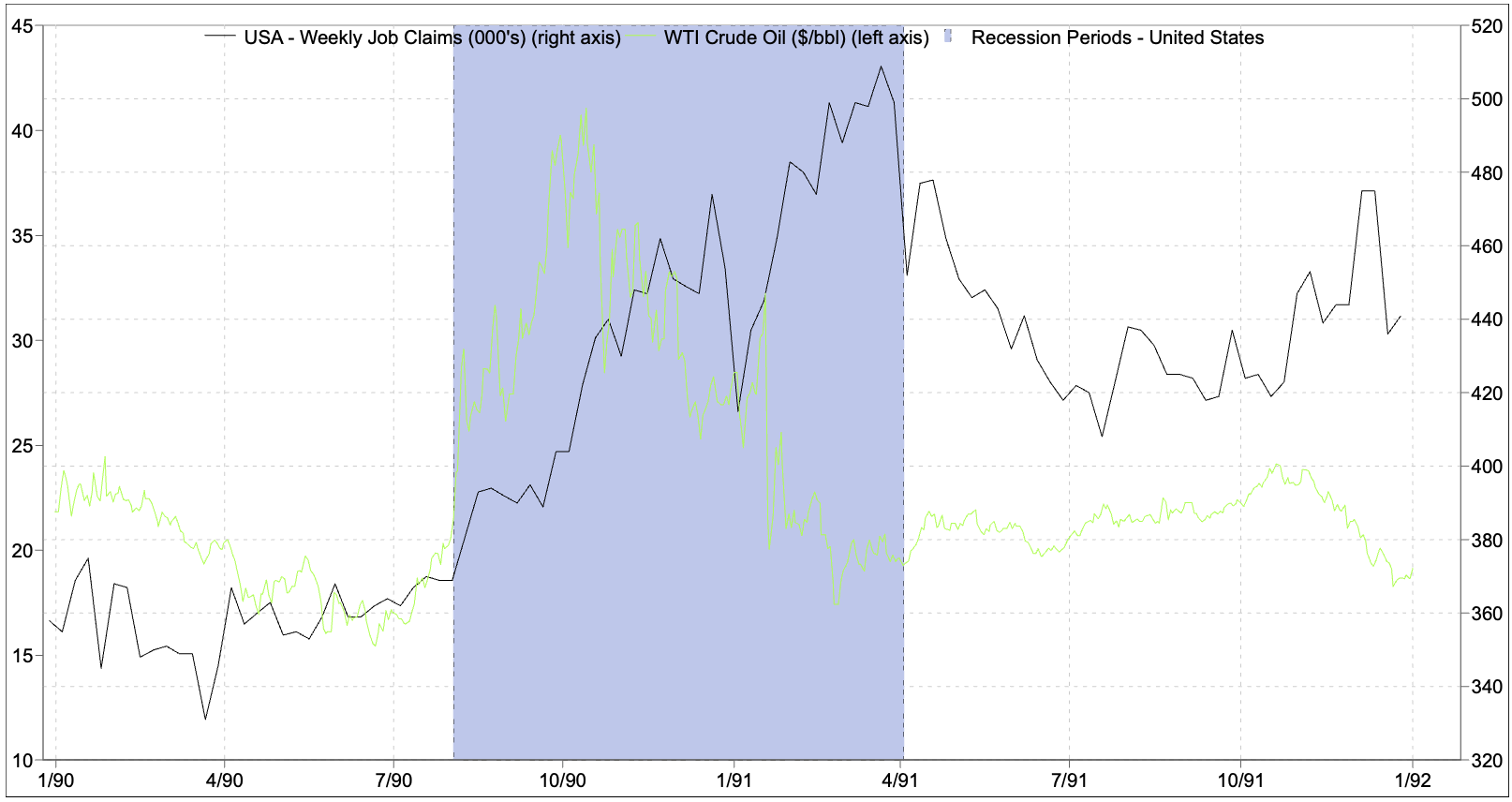
The conflict in Iran that drove oil prices sharply higher during the first quarter began to ease, allowing oil prices to return toward their January levels, and investors once again focused on corporate earnings and the ongoing buildout of the artificial intelligence infrastructure. As war headlines subsided, investors were reminded that many businesses continued to perform very well, with 1st quarter earnings growth for the S&P 500 companies rising more than 30% year-over-year. The economy is also proving to be much more resilient than what was experienced during prior oil spikes. When oil jumped from roughly $20 to $40 during the 1990 Gulf War, weekly unemployment claims skyrocketed from 360,000 to a high of 509,000, and the economy fell into recession. This time around, oil spiked from $60 to $115, but claims have not budged
The AI rollout and buildout have captivated markets for the past year and led to outsized performance of tech shares. This investment has largely been financed by Amazon, Microsoft, Meta, and Google. The substantial cash generation of these companies has been a defining financial characteristic over the years, but the dramatic ramp up in “growth capex” to pay for this AI infrastructure has dinged that image. Collectively, these four companies are spending more than $700 Billion this year, and that figure could top $1 Trillion in 2027². While the speed and the amount of spending have weighed on the stocks of these giants in recent months, it is allowing others to shine. In other words, their spending has become other companies’ revenue, which is one reason why the rally within equities has broadened.
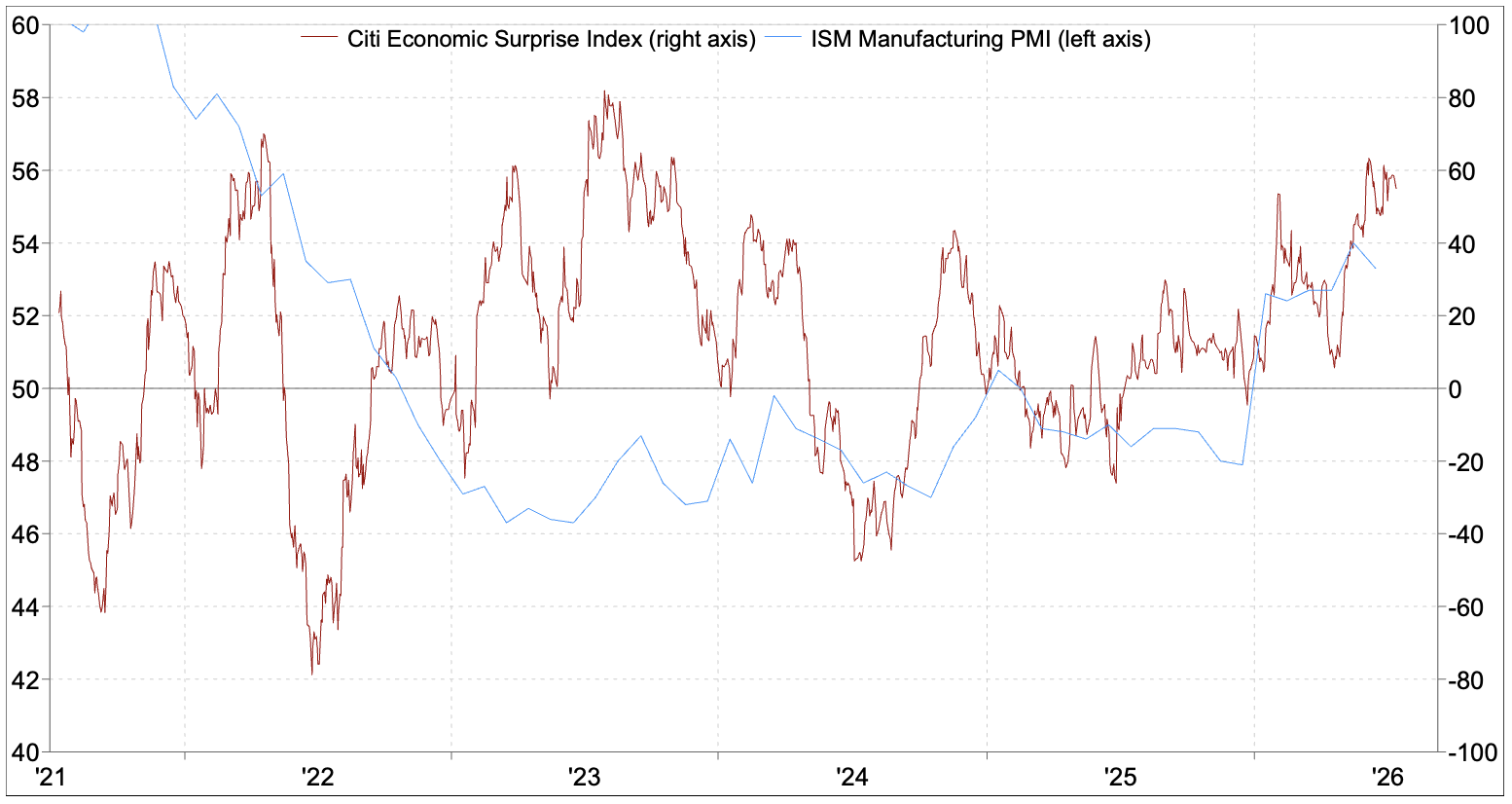
From our perspective, the bigger but less reported story this year has been the clear acceleration in the broader economy. The tech/AI spend is playing a role; growth is not red-hot, but what matters a lot within markets is expectations and the rate of change. The chart below looks at two data series, the Citigroup Economic Surprise Index, which measures how economic data comes in relative to the forecasts, and the ISM Manufacturing Survey or PMI, which is a monthly survey that asks businesses if activity is accelerating or decelerating. The rising ISM illustrates how activity clearly began to accelerate at the end of last year from relatively benign or lethargic levels experienced in the prior three years. In other words, business has been picking up. Additionally, this level of activity is “surprising to the upside” or coming in “above expectations” which in our view is a big reason why markets have performed the way that they have and it is consistent with the strong corporate profit growth mentioned above. The employment picture has followed a similar path of modest growth but an improvement relative to expectations. The monthly payroll numbers declined in 5 of the 12 months of 2025, averaging just 10k jobs added per month for the year, down from 210,000 and 122,000 in the prior two years. Year-to-date, the US is averaging 92,000 jobs added a month. Again, not red hot but an improvement.
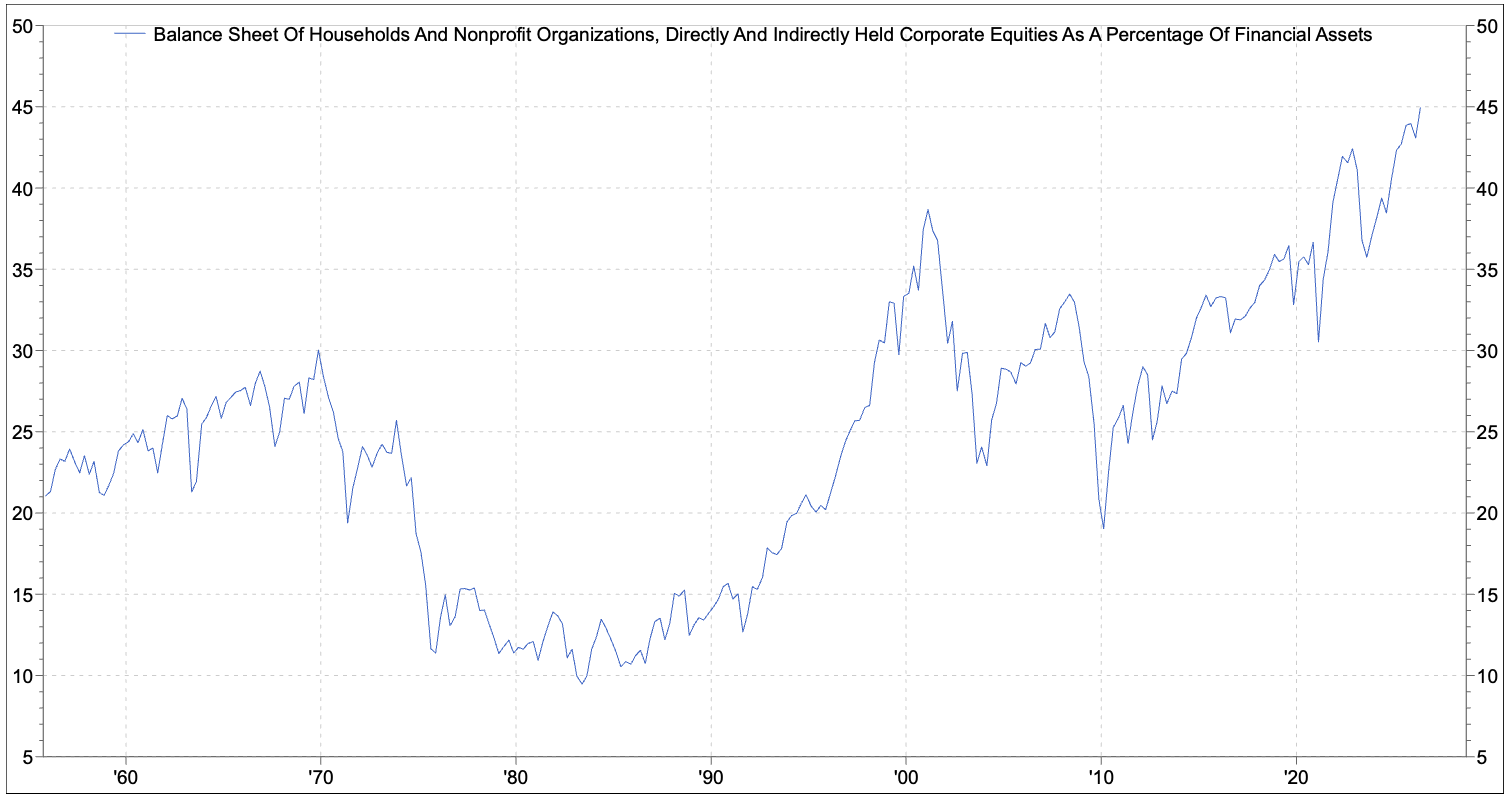
What worries us? With the markets continuing to trudge higher, we naturally have our concerns. As value investors, we cringe at areas of the market that appear crowded or where investors appear to be chasing a story that is already well known. The clear area of extreme concentration of investor attention and market share is the tech sector which now accounts for almost 40% of the S&P 500 Index, surpassing the level reached at the height of the tech bubble of 2000. The counter argument to this concern is that Tech’s earnings more than justify its size and share, so if Tech’s earnings are on the verge of collapse, that is a problem; however that is not our view. Even if the AI investment thesis begins to wobble, we could simply see a rebound in the software stocks and hyperscalers that have sold off over the past year as the capital equipment stocks have rallied. Similarly, investors’ allocation to equities as a percent of their total assets has been flagged for years as a risk, as it has continued to climb to new highs. The “wealth effect” caused by the rising value of equities continues to prop up consumption here in the US and is amplifying the K-shaped economy of haves and have nots. A sustained bear market in equities would not go unnoticed by the economy given this dependency, but again while this remains a concern, we do not see a clear reason to expect this.
Lastly, we have flagged this before in prior commentaries, and at risk of sounding obvious, but a sudden rise in interest rates probably remains the biggest threat to this market, and therefore, the economy. A repeat of 2022, when the 10-year Treasury climbed from 1.5% to 4% sending the S&P down 20%, would be a legitimate worry given the market leadership of technology and other long duration growth companies. Higher rates tend to also highlight hidden weaknesses within the economy and markets such as what we saw in the spring of 2023 with the bank deposit runs or the problems developing in some of the private debt funds. The new Fed chair Warsh has a long and well documented history of having a more conservative posture than many at the Fed, and despite the wishes of his boss, a rebound in inflation would have to be addressed. Again, while this is possible, we are not in this camp, and we would not be surprised if Warsh’s words eventually get watered down. Providing some cover for him in the near term, we do believe that much of the inflationary pressures caused by tariffs last year will continue to abate and hopefully the conflict in Iran cools further.

Tyler Pullen, CFA
Portfolio Manager
¹ Small-Caps Just Had Their Best First Half Since 1991. The Rally Isn’t Over. Barron’s, Jacob Sonenshine, 07/02/2026
² Will Someone Finally Blink in the AI Spending War? WSJ, Dan Gallagher, 7/9/2026
Past performance does not guarantee future results. Market conditions can vary widely over time and can result in a loss of portfolio value. In accordance with the rules of the Securities and Exchange Commission, we notify you that a copy of our ADV, Part 2A and 3 filings with the SEC is available to you upon request. It should not be assumed that recommendations made in the future will be profitable or will equal the performance of the securities in this publication.